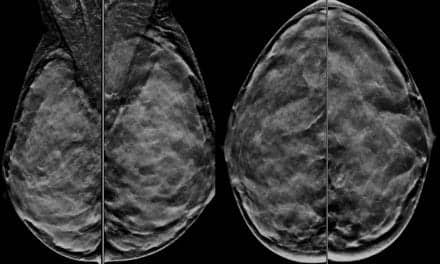
According to research presented at the American Association of Physicists in Medicine (AAPM) meeting in Austin, Tex, July 20 – 24, breast clinics could benefit from implementing a workflow that stratifies women according to volumetric breast density and breast size. This system would allow physicians to weigh the advantages of tomosynthesis against the increased radiation exposure the technology can pose.
The study “Which Women Based on Clinical Benefits and Dose Should Be Considered For Breast Screening with Tomosynthesis?” examines 19 other research studies using VolparaDensity and VolparaDose technology previously presented at the 12th International Workshop on Breast Imaging (IWDM 2014). Researchers compared the mean glandular dose (MGD) received by specific patients undergoing both mammography and tomosynthesis procedures. They found that women with dense breasts (3 or 4 on the BI-RADS scale) received about the same or a slightly lower radiation dose from tomosynthesis as they did from mammography. In contrast, women with lower density breasts received a significantly higher dose from the tomosynthesis exam than from a mammogram.
“While at higher breast density the dose is approximately equal or lower, when comparing MGD in tomosynthesis and mammography examinations at lower breast density, the mammographic dose is lower than in tomosynthesis, sometimes substantially,” said Ralph Highnam, PhD, CEO of Volpara Solutions and a coauthor in the study. “Since the possibility of lesion masking is directly related to breast density, clinicians might want to consider the diagnostic benefits versus the dose given in tomosynthesis.”
Awareness of the dangers of overexposure to radiation from imaging has spread through the Image Wisely campaign and may soon focus on mammography. According to the study, mammography dose is frequently misreported because clinics fail to take into account a patient’s specific breast density. Variations in the algorithms used also make it difficult to compare dose levels across clinics. Evaluating women’s breast density in advance could lead to more accurate dose measurement and ensure each patient receives the minimum dose necessary to obtain meaningful diagnostic results.
“With the breasts’ sensitivity to radiation, achieving diagnostically useful images while keeping x-ray mean glandular dose as low as possible is critical in breast screening,” Highnam said. “The growing adoption of breast tomosynthesis and utilization of shorter screening intervals for high-risk women has the potential to increase patients’ exposure to radiation dose. This has renewed interest in the accurate calculation and tracking of mammographic dose on an individual patient basis.”
For more information about tomosynthesis technology, visit Volpara Solutions.