
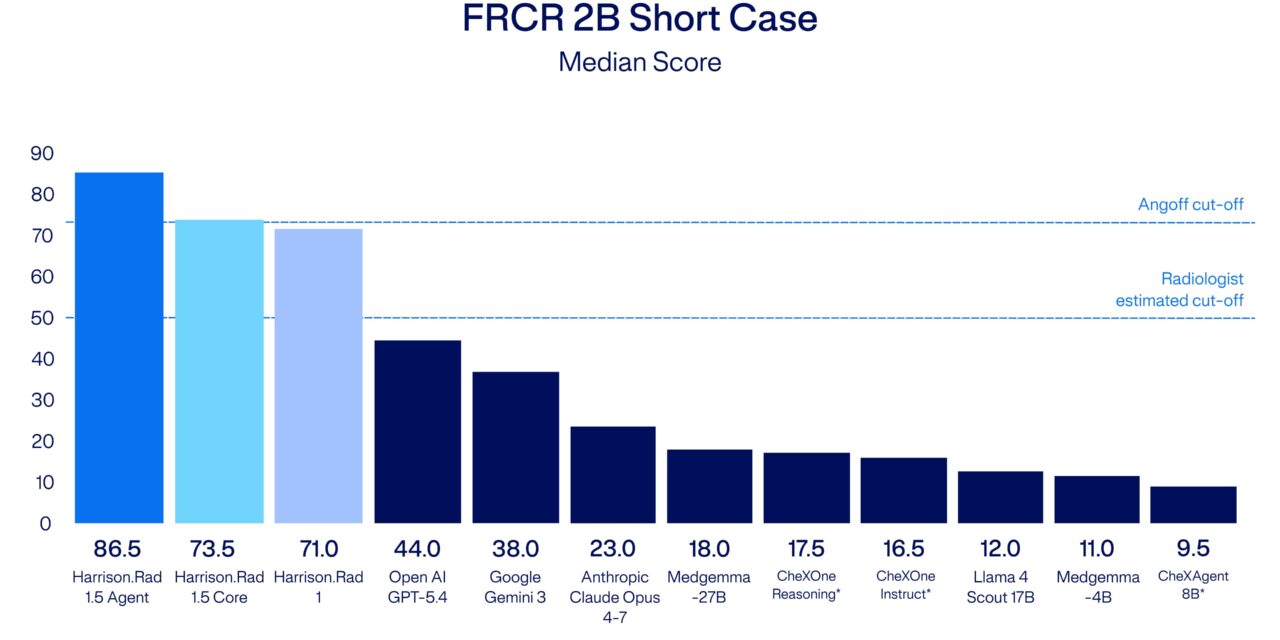
The new model passed the Royal College of Radiologists’ FRCR 2B Short Case, the certification standard taken by UK radiology trainees, while no other evaluated AI model achieved a passing score.
Harrison.ai today launched Harrison.Rad 1.5, a radiology foundation model that can reason over images and clinical context, including priors, to produce a draft report for review by a radiologist. Available now for research at chat.harrison.ai and API access on request, Harrison.Rad 1.5 was the only AI model to pass the FRCR 2B Short Case exam, the standard used to certify UK radiologists, while every other radiology-specific and frontier model evaluated fell short.
Harrison.Rad 1.5 builds on the company’s Harrison.Rad 1 foundation model, released in 2024. Harrison.ai says the new version offers improved performance on complex imaging studies, broader anatomical coverage, and the ability to compare current and prior exams when generating draft reports.
A key feature of Harrison.Rad 1.5 is its ability to generate draft reports. According to the company, the model can analyze imaging studies alongside clinical history and the reason for the exam, then produce a draft report for radiologist review.
“Harrison.Rad 1.5 is the next step towards bringing meaningful innovation forward that will impact the future practice of radiology,” said Dr Aengus Tran, CEO and co-founder of Harrison.ai, in a release. “Reporting is where radiologists spend their time. The future is where our Harrison.Rad foundation model drafts a high-quality report for the radiologist to review and sign off, without replacing their judgement.”
To measure that progress, Harrison.ai evaluated Harrison.Rad 1.5 and other frontier models on an exam human radiologists take, using externally sourced data not seen during training. On the FRCR 2B Short Case, the standard the Royal College of Radiologists adopted in 2025 in place of the now-retired Rapids format, Harrison.Rad 1.5 Agent achieved a median score of 86.5, above the mean cut-off of 73.2 needed to pass. No other evaluated models passed this exam.
On the older FRCR 2B Rapids exam, Harrison.Rad 1.5 Core passed 24.3% of full exam sheets, a 2.4x improvement from Harrison.Rad 1.
“General-purpose models like Anthropic’s Opus and OpenAI’s GPT-5 cannot pass an exam that qualifies a radiologist to practice. Harrison.Rad 1.5 can,” says Dr Jarrel Seah, neuroradiologist and chief medical and AI officer at Harrison.ai, in a release. “It was trained on 6 million diagnostic studies and 18 million clinically crafted conversations. The gains show up most clearly on the hardest cases: studies with priors, post-procedural work, and findings outside the classical reporting ontology. Eighteen months on from Harrison.Rad 1, the gap between our purpose-built model and the world’s leading general-purpose models hasn’t closed; it’s widened. Clinical radiology demands a level of specificity that only comes from purpose-built training.”
Harrison.Rad 1.5’s training on approximately 6 million diagnostic imaging studies was a 33% increase over Harrison.Rad 1. It used new techniques designed for precision and differentiation and an architecture that lets the model adapt how it interprets an image to the clinical question being asked. All of it ran on a new NVIDIA B200 GPU cluster.
Harrison.Rad 1.5 is intended for research, benchmarking, and evaluation purposes only. Harrison.ai is pursuing regulatory clearance, approval, or certification for products built on these foundational models in major markets including the US and EU countries.
Photo caption: Graph showing AI models’ performance on the FRCR exam.
Photo credit: Harrison.ai


