
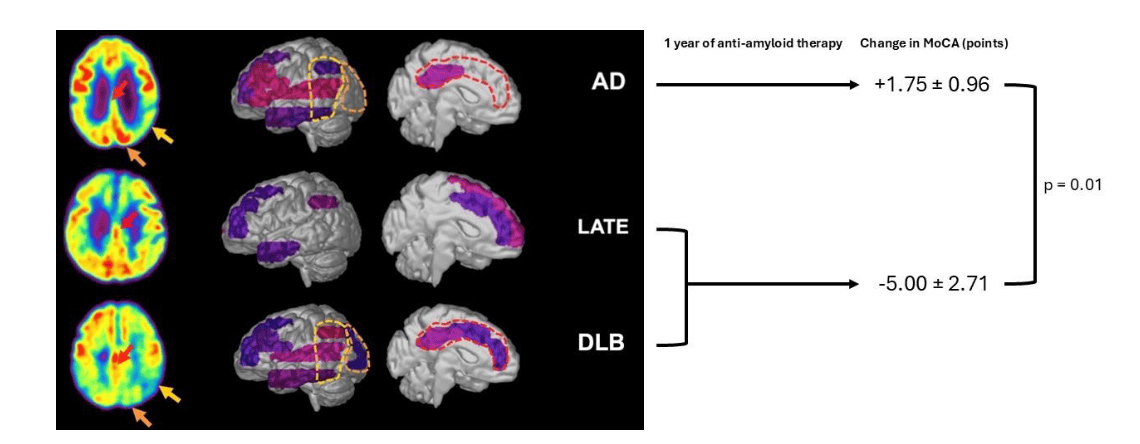
Patients with Alzheimer’s disease-specific metabolic patterns on FDG-PET showed stable or improved cognitive performance after anti-amyloid therapy, while those with other dementia-related patterns experienced cognitive decline.
A specific pattern of brain metabolism visualized with PET imaging may help predict which patients are most likely to benefit from Alzheimer’s disease therapy. In a retrospective study of patients who received anti-amyloid treatments, those with the identified pattern experienced stable or improved cognitive performance, while patients with other patterns experienced significant cognitive decline.
The study was presented at the Society of Nuclear Medicine and Molecular Imaging (SNMMI) 2026 Annual Meeting, where it received the society’s Abstract of the Year award. Each year, SNMMI selects an abstract that highlights advances in nuclear medicine and molecular imaging. This year’s award was chosen from nearly 1,500 abstracts submitted to the meeting.
The hallmark of Alzheimer’s disease is amyloid plaques that accumulate in the brain. Two anti-amyloid therapies that target these plaques were recently approved by the FDA. While these treatments have demonstrated benefit, individual responses vary considerably.
“Numerous large-scale prior studies have shown that many people who meet the requirements for the clinical diagnosis of Alzheimer’s disease as the patients for whom anti-amyloid therapies are currently being prescribed are actually found to have other diagnoses underlying their cognitive impairment after autopsy or long-term follow-up,” says Amanda Rose Nguyen, DO, MS, a clinical fellow in nuclear medicine at the David Geffen School of Medicine at the University of California, Los Angeles, in a release. “This could account for the variability in the success rates of these therapies.”
PET Patterns and Treatment Response
Researchers evaluated the relationship between brain metabolic data from FDG-PET scans, treatment decisions, and clinical outcomes in patients receiving anti-amyloid therapy.
The study examined 124 patients whose cases were reviewed by a university committee for consideration of amyloid immunotherapy. Brain FDG-PET data, treatment decisions, and clinical outcomes were analyzed for all patients who underwent treatment for at least one year. Brain metabolism patterns on PET were categorized as being consistent or not consistent with Alzheimer’s disease, and subsequent changes in cognitive assessment scores were calculated.
Distinguishing Alzheimer’s Disease From Other Dementias
The brain metabolism patterns were representative of Alzheimer’s disease, Lewy body disease, Limbic-predominant Age-related TDP-43 Encephalopathy-type pathology, or frontotemporal lobar degeneration. Patients with Alzheimer’s disease metabolism patterns experienced improved cognitive performance scores, while all other subjects experienced significant cognitive decline.
“This work demonstrates that FDG-PET is an important tool in the diagnosis of dementia,” says Nguyen in a release. “Physicians can use brain metabolic data to help identify individuals who are most likely to benefit from anti-amyloid therapy and potentially avoid ineffective treatment in others.”
Nguyen said larger analyses from an expanded patient population are expected later this year to further evaluate the predictive value of brain metabolism patterns. In the meantime, she recommends gathering comprehensive neuroimaging data to help guide treatment decisions.
Photo caption: Cerebral metabolic patterns of Alzheimer’s Disease (AD, top row), Limbic-Predominant Age-Related TDP-43 Encephalopathy (LATE, middle row), and Dementia with Lewy Bodies (DLB, bottom row). The non-AD group was comprised of patients with LATE and DLB cerebral metabolic patterns. After 1 year of anti-amyloid therapy, the AD group’s MoCA significantly increased by 1.75 0.96 points (p=0.035) while the non-AD group’s MoCA significantly decreased by 5.00 2.71 points (p=0.035). There is a significant difference in the change in MoCA scores between AD and non-AD groups (p = 0.01).
Photo credit: SNMMI. Abstract 262363. “Relationship between Prospective Assessment of Regional Cerebral Metabolism and Subsequent Response to Amyloid-Directed Therapy for Cognitive Decline,” Amanda Rose Nguyen and Daniel H. Silverman, University of California, Los Angeles.